
Exhale longer than you inhale
Feel your feet on the ground — actually feel them
Slow your next decision down
One point, not the match
Say it: "Here."
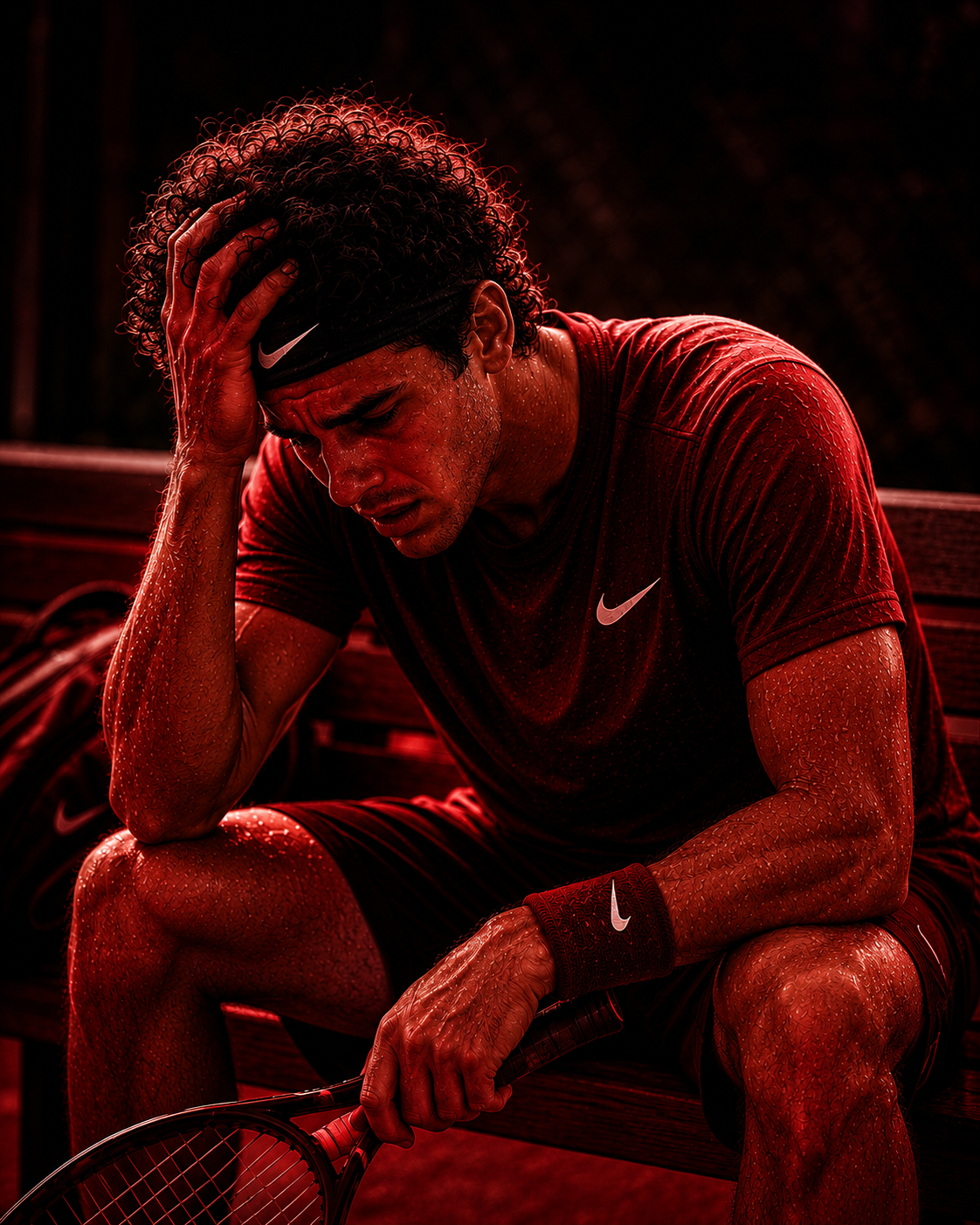
It is anticipation without grounding — a kind of time travel. The player is physically on court, but emotionally already experiencing an adverse result.
It shows up most clearly when the score gets close, the match begins to tighten, expectations rise, and focus drifts to the result instead of the present point.
Anxiety is not weakness. It is disconnection from the present task.
Worry · Nerves · Dread · Overthinking · Panic
Tight scores · Closing out a set · Rising expectations · Rankings on the line · Being watched · A lead that suddenly feels fragile
- Shallow breathing
- Tight chest or stomach pressure
- Restless legs or frozen stance
- Future projection ("what if I lose this?")
- Score awareness replacing point awareness
- Constant self-monitoring
- Shortened routines
- Rushed execution
- Hesitation over commitment
Signal of Departure
Anxiety marks the exact moment your attention left the present. That's useful — if you catch it.
Signal of Meaning
You don't get anxious over matches that don't matter. Anxiety confirms you care.
Early Warning System
Shallow breath and still feet show up before bad decisions do. Read the body first.
Test of Presence
Anxiety asks one question: can you return to now, on demand, under pressure?
Opportunity for Grounding
Every anxious moment is a rep. Breath, feet, target — the return to presence is a trainable skill.
It slowly changes the structure of their tennis: shot-making goes conservative, swing becomes protective, rhythm disappears between points, creativity is replaced with caution, aggression becomes hesitant or forced.
The biggest effect is this: the player stops competing one point at a time and starts chasing the outcome.
- Serve routine rushing as the score tightens
- Feet going quiet between shots
- Shot-making swinging between too safe and too forced
- Rhythm dissolving between points
- Technique that was automatic suddenly needing supervision
- Chasing the outcome instead of competing one point at a time
- Playing practice sets tight when they "count"
- Over-thinking mechanics that were grooved
- Asking for constant reassurance
- Rehearsing worst cases instead of patterns
- Losing sleep the night before matches
- Playing the draw out in your head days in advance
- Stomach in knots on the drive to the courts
- Result-checking, ranking-watching, scenario-spinning
⚠ What It Does Under Pressure
At 30–30, break point, or closing moments: anxiety compresses decision time, increases hesitation in swing, creates over-management of technique, disrupts natural rhythm built earlier in the match.
You're still out there, playing your match. But inside, your emotions have left the moment.
✓ Early Recognition Switch
If recognized early, anxiety becomes a signal — not a verdict. The moment you name it, you can act on it. Return to breath, feet, and the next ball.
Players who manage anxiety become more present, more decisive, and better at trusting their rhythm under pressure.
Reframe / Self-Talk Shifts
This is the full practical system. Do not add anything else. Do not over-analyze. Simplify.
- "Back to basics."
- "Next point only."
- "Play healthy margins."
- "Stay right here."
- "Nothing outside this point."
- "Here."
- "One ball."
- "Commit."
Process Goals
Before every practice and match, set one process goal you can control — effort, footwork, routine, margins. Let outcome take care of itself.
Breath Awareness
Train the exhale. In practice, between every drill, exhale slowly. Build the habit before the pressure arrives.
Recovery Between Points
Fatigue accelerates anxiety. Manage recovery off court — sleep, nutrition, and emotional regulation between sessions — not just between points.
Guard the Routine
Anxiety attacks routines first — the rushed serve ritual is the first domino. Rehearse your between-point routine until it's harder to skip than to keep.
Anxiety in tennis is impossible to fully eliminate. It is a signal that your attention has left the moment.
The solution is not more control. It is less future.
Flow does not come from forcing calm. It comes from restoring presence. The sequence is always the same: Find your breath. Feel your feet. See the ball. Pick your target. Trust your rhythm.
When Anxiety Starts Coaching
Barry Buss · Reset talk · Between-point presence
An anxious player doesn't need stakes reminders, scenario talk, or "you've got this" pressure.
They may need: simple language, a steady presence, fewer instructions, a return to controllables, and one grounding reminder.
For parents and coaches: never talk about the future to a player who's already trapped in it. Bring them back to now.
I can be anxious and still compete.
I can be anxious and still find my rhythm."
Anxiety pulls players away from the present. The path back is always the same: