
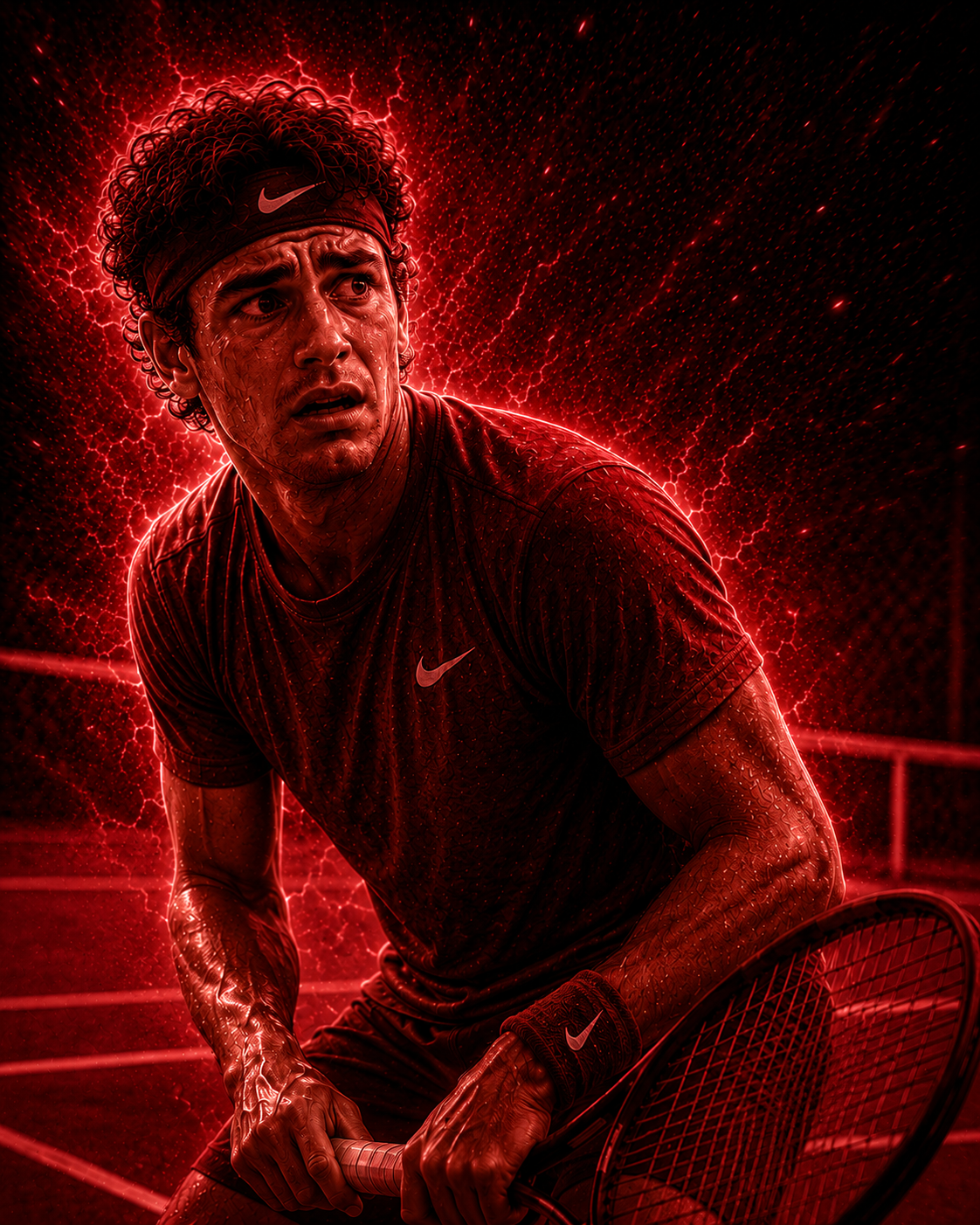
Fear in tennis is not fear of injury or of the opponent. It is fear of outcome — the brain stops competing for the point and starts protecting the result. It creates hesitation at the exact moment commitment is required.
Similar Emotions
Dread · Timidity · Hesitation · Self-Protection · Playing Scared
Common Triggers
Serving out a set · Break points · Playing someone you "should" beat · A lead worth protecting · Being watched · A history of choking the same moment
What It Feels Like
Emotionally: Guarded, tentative, braced for the worst. Mentally: Previewing the miss before the swing, consequences louder than targets. Physically: Tight chest, breath high and shallow, weight drifting backward at contact, swing decelerating exactly when it should accelerate. Behaviorally: Pushing instead of swinging, retreating a step per game, pausing before every commitment.
What It Sounds Like in Your Head
"Don't miss." · "Just get it in." · "Play safe here." · "Don't give it away." · "I can't lose this point."
That voice feels responsible. It isn't competing. It's protecting — and protection doesn't win points. It just postpones losing them.
What It Looks Like in Tennis
The swing turns into a push. Targets shrink toward the middle. First instinct gets overruled by the "safe" choice — a beat too late. The first serve loses pace and the second serve loses purpose.
What It Is Trying to Tell You
Fear is not prediction. It is interpretation. The outcome has gotten too big in your mind — nothing in the match has changed. Only the story you're telling about it.
Fear shows up the moment a match starts to feel like something that can be lost emotionally, not just competitively.
It is self-protection showing up where it was never invited: mid-swing. The player stops trying to win the point and starts trying not to lose it.
That shift is subtle. It changes everything.
Fear is not weakness. Every competitor feels it. The question is whether your feet, your targets, and your swing keep moving forward while it's talking.
Signal of Stakes
Fear only visits matches that matter to you. Its presence means you care.
Signal of Outcome-Watching
It marks the moment attention left execution and drifted to consequences.
Protection Instinct
Your brain is trying to keep you safe from a threat that isn't physical. Thank it. Then swing anyway.
Test of Commitment
Fear asks one question: will you still swing full when it counts?
Opportunity for Courage
Courage isn't the absence of fear. It's a full swing with fear on board.
In Competition
- Pushing instead of swinging when the score tightens
- Targets retreating to the middle of the court
- Tentative serves in big moments
- Winning opportunities declined instead of created
- Court position drifting backward, game by game
- Rally intent shifting from building to surviving
In Training
- Practicing brave, competing careful
- Avoiding the shot that needs the most work
- Playing point games conservatively to protect the "win"
- Choosing drills you're already good at
Off the Court
- Dreading upcoming matches instead of planning for them
- Avoiding tougher tournaments to protect the ranking
- Downplaying goals so falling short hurts less
- Rehearsing failure the night before
⚠ Short Term / Danger Habit
Fear rarely collapses a game all at once. It reshapes it quietly: shorter swings, deeper court position, decisions a half-second late, aggression gone exactly when it's needed.
As a habit, it builds a player who practices brave and competes careful — and tennis punishes neutrality.
✓ Early Recognition Switch
Caught early, fear becomes a cue: step in, expand the target, commit before the point starts. The body leads and the mind follows.
Players who learn to swing through fear own the biggest points — because most opponents are busy protecting themselves.
Reframe / Mantra
Rehearse Pressure
Play practice points with consequences — sprints, score handicaps, must-hold games. Fear loses power over moments you've already visited.
Track Your Shrink
After matches, note where the swing got short: score, opponent, moment. A mapped pattern is a manageable pattern.
Practice Committing Early
In practice, call your target out loud before each serve and return. Train the habit of deciding before the point — so under pressure there's nothing left to negotiate.
Fear is unavoidable in tennis. You're alone out there. The scoreboard is public. Every miss has your name on it. Every competitor will meet fear — usually at the exact moment they most want to play well.
The question is not whether you will feel it. The question is whether your feet keep moving forward while it talks.
Fear does not have to become retreat. It can become the cue to step in.
Barry Buss · 90-second reset talk · Swinging through the fear
Reset talk · Swinging through, not steering
They need: permission to miss, forward language, and total belief in their swing.
Coach: "Step in." "Be brave." "Trust your swing."
Parent: "Play forward." "Stay with your game." "Trust it."
Player (self-talk): "Forward." "Commit." "Swing."
For parents and coaches: never add stakes to a player already carrying too many. Shrink the moment, not the swing.
I can feel fear and still swing full.
I can feel fear and still play forward."
Flow doesn't come from removing fear. It comes from moving through it. Fear pulls players backward and inward. The path back:
Red alerts are alarms.
The player who plays not to lose is already losing.
Breathe. Step In. Swing. →